The First 24 Hours: How A New YouTube Video Really Gets Picked Up
There was a stretch of years when the accepted answer to “how do I make a video take off” was, more or less, push numbers into it. Buy views, trade views, run it through a click farm, let a bot leave twenty comments. Some of that worked for a while. It stopped working, and the ways it stopped working got expensive.
I have been making YouTube content since 2017, and these days the channels I build and teach are faceless ones aimed at viewers in the US, the UK, Germany and Japan. What I want to lay out here is what actually happens in the first 24 hours after you publish, why that window decides so much, and what you can honestly do inside it.
How YouTube tests a new video
The mental model that has served me best is simple: small test, then scale.
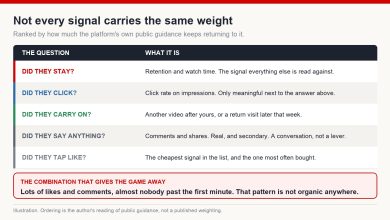
When a video goes live, it is not broadcast to your whole subscriber base and the wider recommendation surface at once. It goes to a small group first – people who look, on paper, like they should want it. YouTube then watches what that group does. Do they click when the thumbnail appears? Do they stay past the opening? Do they finish? Do they watch something else afterwards? Do they come back?
If those answers are good, the test group widens. If the click-through rate is weak or the retention graph falls off a cliff in the first minute, distribution quietly stops expanding. The video is not banned or punished. It simply never gets a second test.
That is why the first day matters out of all proportion to the rest of a video’s life. Not because there is a secret window you have to game, but because the sample YouTube is judging you on is collected then.
What breaks the test: bought, traded and botted traffic
Here is where a lot of new creators sabotage themselves, usually with good intentions.
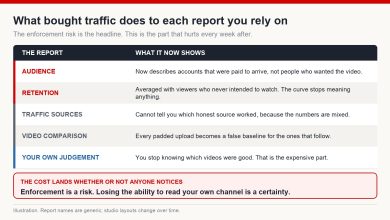
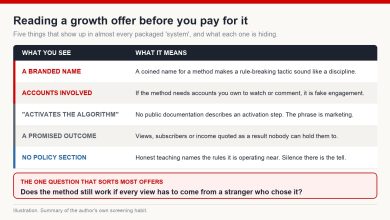
The tempting move is to make that early sample look better than it is: traffic exchanges, auto-click services, watch-time bots, purchased comments, or blasting the link into groups full of people who have no interest in the topic. The view counter moves. Then, within a few days, impressions collapse, the video disappears from browse and suggested surfaces, and nobody can explain why.
Two things are going on. The first is policy. YouTube’s spam and deceptive practices rules treat artificially inflated metrics as fake engagement; that traffic can be stripped from your stats, videos can be removed, and repeated offences can end a channel. This is not a rumour creators tell each other – it is written policy with real enforcement behind it.
The second is arithmetic, and it bites even when nothing is detected. A thousand views from people who do not care about the topic will produce a worse retention curve, a worse click-through rate on the next impression, and a worse audience profile than a hundred views from people who do. You have not helped the test. You have failed it more convincingly, and taught the system to show your next video to the wrong people.
A thousand wrong viewers are worth less than a hundred right ones. On a faceless channel aimed at an English-speaking audience this is even harsher, because the whole value of the channel sits in reaching a specific audience in a specific country.
What promotion can honestly mean in hour one
None of that means you have to publish and walk away. It means the traffic you bring has to be traffic that might genuinely want the video.
- The community tab. The most underused surface on YouTube. A post an hour before publishing, or right after, reaches people who already chose to follow you.
- Subscriber notifications. Free, and dependent entirely on whether your last few videos were worth the click.
- A Short that points at the long video. Tease the result in the Short, explain the process in the long form.
- A pinned comment on an older video that covers the same ground, especially one still getting steady traffic.
- An email list, if you have one.
- Communities you actually belong to – a niche forum, a Discord server, a subreddit – where you are a participant, not a drive-by link dropper. If you would not post there without a video to promote, do not post there with one.
The distinction that matters is intent. Every one of those people is choosing to click because the topic interests them. That is the only kind of early traffic that helps.
Hour one is a click-through-rate problem
In the first hour, the thumbnail and title are doing nearly all the work. The question YouTube is effectively asking is: does anyone stop for this?
A good thumbnail is not the prettiest one. It is the one that creates a stop – a clear focal point readable at the size of a thumbnail on a phone, strong contrast, and some visual tension that leaves a question open. A beautifully composed image that says nothing will lose to a rougher one that makes you wonder what happened.
The most common self-inflicted wound here is putting the title text on the thumbnail as well. That kills the curiosity twice over: the viewer reads the same sentence in two places and there is nothing left to find out. The working relationship is the other way round:
- Thumbnail raises the question.
- Title hints at the answer.
They should complement each other, not compete. If your thumbnail shows a wall of a hundred generated video files, the title should not say “I made a hundred videos” – it should say what happened when you did.
The first 24 hours belong to retention
Click-through gets people in. Retention decides whether YouTube keeps opening the door.
The most common leak is the opening. Channel animation, logo sting, music bed, a slow throat-clearing paragraph before the topic starts – and the audience is gone before the video has said anything. The retention graph shows that as a vertical drop in the first ten seconds, and once it is there no amount of good material later in the video can undo it.
A strong hook does not need drama. It needs to name the thing the viewer already cares about and promise something specific and slightly surprising. Something with the shape of: “this one change nearly doubled the revenue per thousand views on this channel – and I did not change the content at all.” Concrete, specific, and it opens a loop the viewer wants closed.
Test your opening the same way you would test a thumbnail. Watch the first fifteen seconds of your own video with the sound of someone who does not care about you, and see whether you would keep watching.
Day two and three: read the data, do not guess
This is the point where the work becomes analytical instead of creative. The numbers worth looking at are click-through rate, retention at thirty seconds, average view duration, where the traffic came from, and whether any returning viewers showed up.
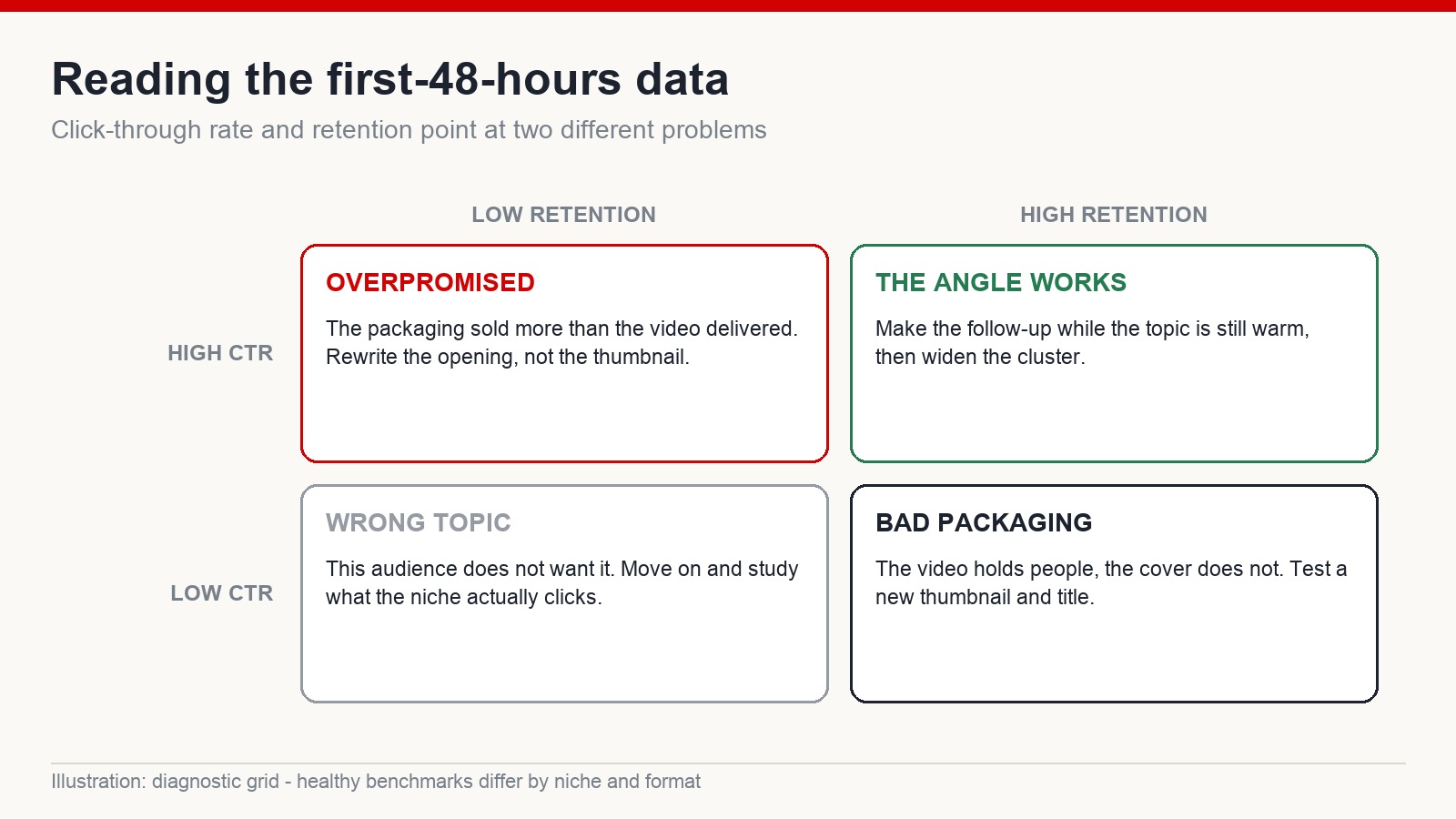
Two of those numbers together tell you what to fix:
- High click-through, poor retention. The packaging sold something the video did not deliver. Do not touch the thumbnail – rewrite the opening, and pull the promise back to what the video actually does.
- Good retention, low click-through. The video is fine; the cover is not. This is the cheapest problem to fix. Test a new thumbnail, then a new title.
- Both weak. Usually the topic, not the execution. Go and study what this audience actually clicks on before making the next one.
- Both strong. Do not celebrate – build. Make the follow-up while the topic is still warm.
Swapping a thumbnail a few hours after publishing is a normal, sanctioned thing to do, and I have seen it change the trajectory of a video that was about to stall. It is not a reset button, though. If retention is the problem, a new thumbnail just brings more people to the same exit.
What are healthy numbers? Honestly, it depends more on your niche and format than anyone selling benchmarks will admit. Search-driven how-to content, browse-driven entertainment and Shorts all behave differently. The number that matters is your own channel’s median: compare each video to your last ten, not to a figure from someone else’s dashboard.
Scaling a winner without repeating yourself
When a video works, the instinct is to make it again. That instinct is right, and most people execute it wrong by essentially re-uploading the same video with a different thumbnail. Repetitive, low-differentiation output is exactly what YouTube’s policies on repetitious content are aimed at, and audiences spot it even faster than the system does.
The productive version keeps the insight and changes the frame: a different angle, a different hook, a different audience, a different structure, a different pace. One idea – say, that a particular tool cuts production time in half – can honestly support several videos if each one is genuinely made for a different person: someone doing this alongside a full-time job, someone doing it for a client, someone doing it at scale. Same insight, different videos.
A first-48-hours checklist
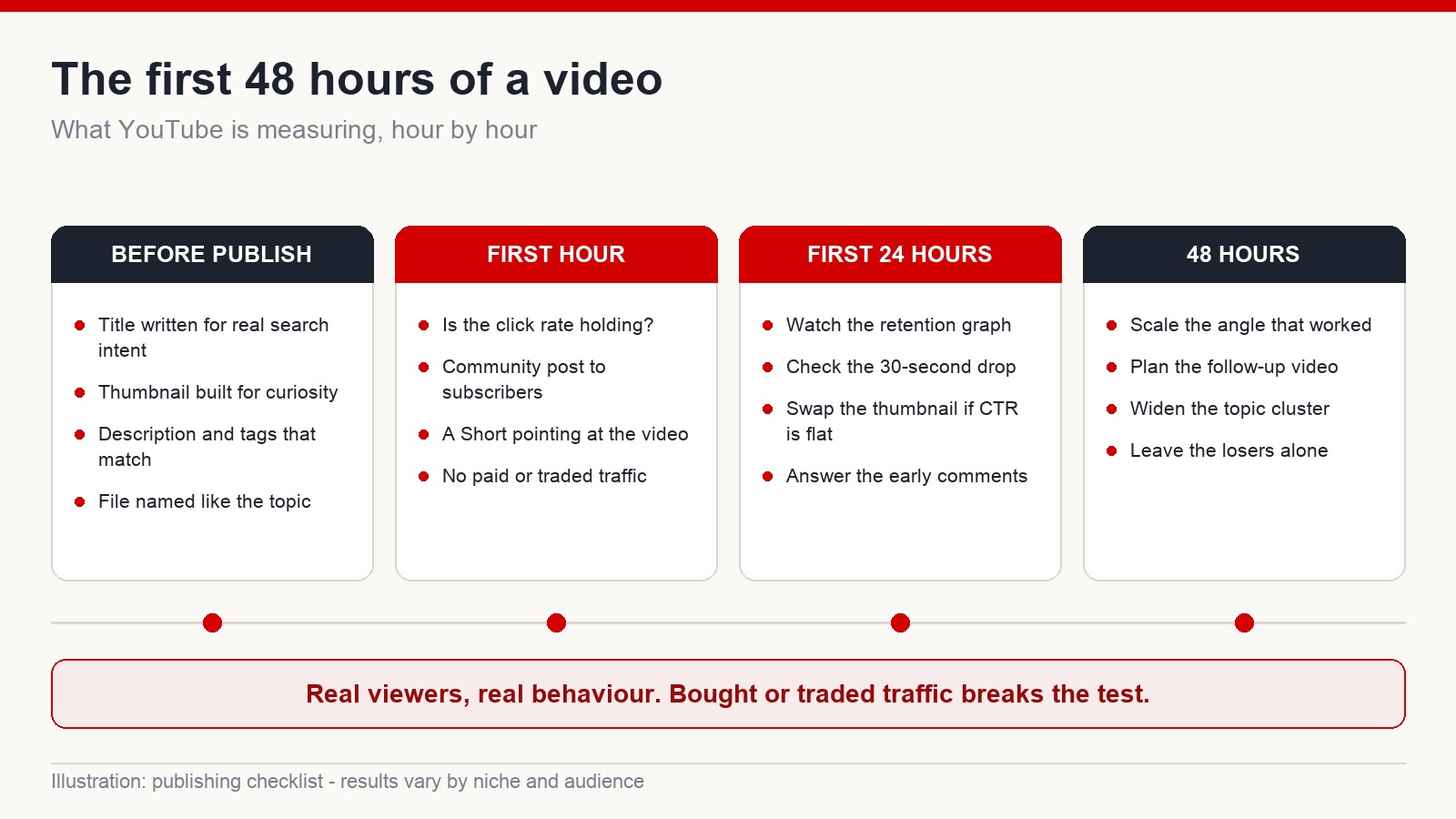
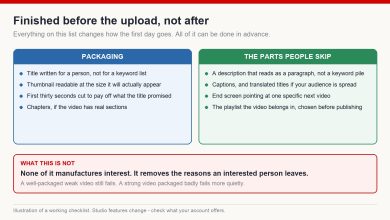
Before publishing: title written for what people actually search, thumbnail built for curiosity, description and tags that match the topic, sensible file name.
First hour: community post, subscriber notifications, a Short pointing at it if you have one, and nothing bought or traded.
First 24 hours: watch the retention graph, check the thirty-second mark, replace the thumbnail if the click-through rate is flat, answer the early comments properly.
48 hours: scale the angle that worked, plan the follow-up, widen the topic cluster around it, and leave the video that did not work alone.
Frequently asked questions
Does promoting a new video still work?
Yes, when the traffic is real and relevant. Bringing your own audience to your own video is normal. Buying or trading traffic is a different activity with a different outcome.
How important are the first 24 hours?
Very. It is the window in which YouTube collects the sample it uses to decide how far to distribute the video.
What click-through rate should I aim for?
It varies enormously by niche, format and traffic source. Rather than chasing a universal number, compare each video with the median of your own last ten.
Should I change the thumbnail after publishing?
If the click-through rate is clearly below your own norm in the first hours, yes – it is a legitimate and often effective fix. If retention is the weak number, a new thumbnail will not help.
Can a faceless video still get recommended?
Yes, provided it is genuinely made rather than assembled – a real angle, a real opening, and retention that holds. Thin or duplicated content struggles regardless of whether a face appears in it.
The short version
YouTube is not short of creators who work hard. It is short of creators who understand how attention is won and held. The first 24 hours are where that gets measured, and almost everything that decides the outcome – the thumbnail, the opening, the honesty of the promise, the relevance of the people you bring – is chosen before you press publish.
If you want the whole workflow I use for building faceless channels aimed at English-speaking audiences, it lives on mmoyoutube.com. Results vary, platform policies change, and no method makes a video take off on demand.